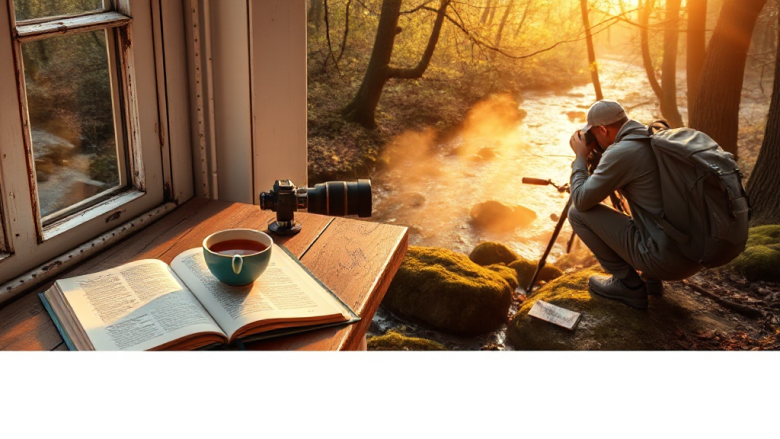
You finally bought a proper camera. You’ve spent a few weekends in the woods, crouched by streams, chasing golden light through the trees. And yet, when you get home and open the files, the photos look flat. The deer is there, but it’s small and dull. The waterfall is there, but it looks like grey soup. You know the gear isn’t the problem — you’ve seen what other people do with the same camera.
So you start looking for the best resources for learning nature photography. And that’s where the real problem begins. There are thousands of options: books, online courses, workshops, YouTube channels, local camera clubs. Some cost nothing. Some cost more than your lens. Some will genuinely change how you see, and some will just eat your evenings. This isn’t a ranked list of brands. It’s a practical map of resource types, judged on cost, depth, and the one thing most beginners underestimate — feedback.
Books and Field Guides: Cheap Depth, Slow Feedback
Books are the cheapest way to go deep. A good nature photography book costs less than a single tank of fuel, and it will sit on your shelf for years. The strength of books is structure. A well-written guide takes you from exposure fundamentals through composition, light, weather, and fieldcraft in a logical order. You can read a chapter, go out, practise, and come back. That rhythm suits people who like to think before they shoot.
The weakness is feedback. A book can tell you that backlighting creates rim light on fur, but it can’t look at your attempt and say the rim is too weak because you metered off the wrong spot. Books also age. Camera-specific advice goes stale fast, so favour titles about light, composition, and animal behaviour over ones about menu settings. If you’re the kind of person who learns by reading and re-reading, a couple of good books plus a notebook will take you further than a dozen random videos. If you need someone to tell you what you did wrong, books alone will leave you stuck.
Online Courses: Structured Learning With a Price Tag
Online courses sit in the middle. They’re more expensive than books, usually less than a workshop, and they offer something books can’t: demonstration. Watching someone adjust exposure compensation while a heron stalks through reeds teaches you faster than reading about it. The best courses break nature photography into modules — gear and settings, light and weather, composition, wildlife fieldcraft, editing — so you can see where you are and what comes next.
Cost varies wildly. Some subscriptions give you a library for a monthly fee; others sell one-off courses that you keep. Depth also varies. A short course on bird photography might be three hours and genuinely useful. A sprawling ‘masterclass’ might be twenty hours of talking head with very little field work. Before you buy, check whether the course includes assignments or critique. A course with feedback is worth three without it. Courses suit self-directed learners who want structure but can’t commit to fixed dates. They don’t suit people who need a deadline and a person watching.
Workshops and Field Trips: Expensive, Fast, Unforgettable
Workshops are the most expensive resource on this list, and for many people they’re the fastest route to improvement. You pay for access, guidance, and immediate feedback in the field. A good leader will stand behind you, look at your frame, and say: move two steps left, drop your tripod, wait for the cloud. That kind of correction sticks because it happens in the moment, with the subject in front of you.
But workshops have traps. Group sizes matter. Six people around one fox is a crowd; twelve is a scrum. Some workshops are really tours with a photographer attached, and you spend more time in a minibus than behind the camera. Ask how many participants, how much walking, and whether the leader will actually review your images. Also check the refund policy — weather cancels trips, and so do bad seasons. Workshops suit people who have the basics and need fieldcraft, confidence, and honest critique. They don’t suit complete beginners who don’t yet know what aperture does; you’ll pay a lot to be told things a book would have covered for a tenner.
YouTube Channels and Podcasts: Free, Uneven, Surprisingly Useful
YouTube is where most people start, and it’s easy to see why. It’s free, endless, and often beautiful. A skilled creator can show you a full shoot — the location, the settings, the failures, the final edit — in twenty minutes. That transparency is valuable. You see that good photographers miss focus, wait for hours, and come home with nothing. Podcasts are the audio version: useful for learning how professionals think about seasons, ethics, and patience while you’re driving to a location.
The problem is signal. For every channel that teaches properly, there are dozens that chase gear reviews and clickbait. Free also means no feedback, and no sequence. You can watch fifty videos and still not know what to practise next. Use YouTube deliberately: pick one topic — say, photographing moving water — watch three videos on it, then go shoot it. Treat it as a supplement, not a curriculum. It’s brilliant for specific techniques and for seeing how other people work. It’s poor at telling you what you personally need to fix.
Local Clubs, Mentors and Community: The Feedback You Can’t Buy Elsewhere
Local camera clubs and nature groups are the most underrated resource. They’re cheap, sometimes free, and they provide the one thing money struggles to buy: regular, honest feedback from people who know your local patch. A monthly print competition or a shared walk will teach you more about composition than a year of solo shooting, because someone will finally tell you that your horizon is crooked and your subject is lost in the frame.
Mentors are the concentrated version. One experienced photographer who agrees to look at ten of your images and tell you the truth is worth more than a shelf of books. Finding one isn’t easy. Clubs are the usual route — volunteer to help on a project, ask questions, be useful. Conservation groups and wildlife trusts often need photographers for surveys and events, which gives you access and a reason to shoot with purpose. Community also keeps you going through the flat months when motivation dips. The downside is pace. Clubs move at the speed of their slowest member, and some are more social than educational. Visit twice before joining.
If you want one short list to keep in mind, it’s this: books for depth, courses for structure, workshops for speed, YouTube for specifics, clubs for feedback.
How to Combine Resources Without Wasting Money
The mistake most people make is treating these as alternatives. They’re not. They’re layers, and the best resources for learning nature photography depend on which layer you’re missing.
Start with one book on light and composition. Read it slowly. Then pick one online course that matches your main interest — birds, landscapes, macro, mammals — and work through it with your camera beside you. Use YouTube only when you hit a specific wall: how to focus on a moving subject, how to shoot in fog, how to edit without overdoing it. Join a local club or find a mentor for feedback, because that’s the layer you can’t self-serve. Save workshops for when you know what you want to learn and you’re ready to be corrected in the field. One good workshop at the right moment beats three early ones.
Budget matters, but not in the way people think. Spending a little on a book and a club membership will outperform spending a lot on a workshop you’re not ready for. The reverse is also true: if you’ve read everything and still can’t get sharp shots of birds in flight, a single day with someone who does it well is worth the money.
So which format actually helps you improve? If you’re flat and stuck, the answer is usually feedback. Books and videos can teach you what good looks like, but only a person — a mentor, a club, a workshop leader — can tell you why your version isn’t there yet. Pick the resource that closes your specific gap, not the one that looks most impressive. Then go outside and use it. The best resource is the one that gets you back in the field with a clearer idea of what to practise next.