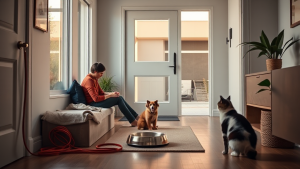
You notice it at 7pm on a Tuesday. Your cat is sitting in the middle of the living room, staring at a blank wall. Not blinking. Not moving. Just staring. Or maybe it’s the over-grooming — a bald patch on the flank that wasn’t there last month. Or the 4am sprint across your head that’s stopped being funny. You start to wonder whether flat life is actually enough for a cat, or whether you’re keeping a small wild animal in a box and calling it fine.
There’s a myth that indoor cats are automatically happy because they’re safe. No cars, no foxes, no fights, no fleas. All true. But safety isn’t the same as satisfaction. Cats are built for hunting, climbing, patrolling territory and solving small problems. When none of that exists, they don’t just shrug and nap. They redirect. Into over-grooming, wall-staring, furniture scratching, litter box protests, or a kind of low-grade grumpiness that owners often mistake for personality.
This is a diagnostic checklist. Read the signals first, then match each one to a fix. Learning how to keep indoor cats happy is mostly about rebuilding the parts of outdoor life that actually matter — vertical territory, hunting sequences, sensory variety — inside a flat or small house.
Reading the Signals: What Boredom and Stress Actually Look Like
Boredom in cats is quiet. It rarely looks like a dog chewing the sofa out of frustration. It looks like small, persistent oddities that build up over weeks.
Over-grooming is one of the clearest. A cat that licks a patch on its belly or inner thigh until the fur thins is often under-stimulated or mildly anxious. It’s not a skin problem until a vet says it is — but if the skin is clean and the licking continues, look at the environment first.
Wall-staring, ceiling-staring and long periods of motionless sitting are another signal. A cat that’s genuinely relaxed sleeps in loose, sprawled positions. A cat that’s under-stimulated sits rigid and alert, watching nothing. It’s waiting for something to happen. Nothing does.
Then there’s the evening chaos. The zoomies at 10pm, the ankle ambushes, the yowling in hallways. Owners often read this as the cat being playful. Sometimes it is. But when it happens every night at the same time and the cat seems wired rather than joyful, it’s usually a hunting drive with nowhere to go.
Watch for the litter box too. A cat that starts peeing outside the tray, or hovering rather than squatting, may be stressed rather than ill. Get a vet check first. If the vet finds nothing, the answer is almost always environmental.
Finally, appetite and interaction changes. A bored cat may nag for food constantly, or lose interest in the toys it used to love. Both are worth taking seriously.
Vertical Territory: Why Your Cat Needs the Upper Half of the Room
Cats are not floor animals. In the wild, they use height to survey territory, escape pressure and rest safely. A flat with no vertical space forces a cat to live at ground level, which is the level where humans, vacuum cleaners and other pets move. That’s stressful.
The fix is to give your cat the upper half of every room it uses. This doesn’t mean turning your home into a cat playground. It means a few well-placed surfaces that let the cat get up and out of the way.
Start with what you already have. A sturdy bookshelf cleared on one shelf. A wardrobe top with a folded blanket. A windowsill wide enough to sit on. A kitchen counter is usually off-limits, but a wall-mounted shelf above the counter is fine — the cat just wants the view and the elevation, not the food.
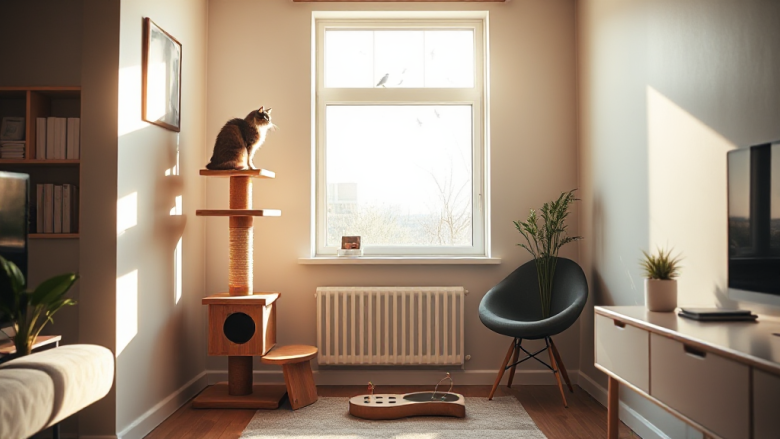
Cat trees work, but tall thin ones wobble, and a wobbling tree is worse than no tree. Look for something with a wide base, or bolt it to the wall. Place it near a window if you can. A high perch with a view of the street is the single most valuable piece of furniture in a bored cat’s life.
If you have more than one cat, height matters even more. Vertical space lets cats avoid each other without conflict. Two cats on the floor with one resource will squabble. Two cats on different shelves will ignore each other happily. Add a second route up — a chair, a stool, a shelf — so no cat gets trapped in a corner.
Don’t forget the quiet spots. A cat needs somewhere to hide that isn’t a litter box or a carrier. A cardboard box on top of a wardrobe, a covered bed in a corner, a cupboard left slightly open. Boredom and stress overlap here: a cat with no retreat will pace, and a pacing cat is a bored cat.
Daily Play and Hunting Sequences: The Part Most Owners Get Wrong
Most people play with their cat for three minutes with a wand toy, then stop when the cat loses interest. That’s not a hunting sequence. That’s a warm-up.
A real hunting sequence has four stages: stalk, chase, pounce, catch. A cat that only gets to chase never gets the payoff, and the payoff is what releases the tension. Without it, the cat stays wired, and the wiring shows up as 10pm zoomies or ankle ambushes.
The fix is to run two proper sessions a day, roughly ten to fifteen minutes each. One in the morning, one in the evening. The evening one matters most — it should end with a meal or a small snack, then grooming, then sleep. That mirrors the natural hunt-eat-groom-sleep cycle and is the closest thing to a reset button for a bored indoor cat.
Use a wand toy with feathers or a small fabric mouse. Move it like prey: dart under a rug, pause behind a chair, twitch, then run. Let the cat catch it. Let it hold the toy for a few seconds. Then repeat. End the session with the cat catching the toy properly, not with you putting it away mid-pounce.
Vary the toys. A cat that sees the same red feather every day stops seeing it as prey. Rotate between two or three wand attachments, a laser pointer used carefully, and a few small toys the cat can bat around alone.
Food puzzles do some of this work for you. A puzzle feeder, a snuffle mat, or even a few kibbles hidden around the room turns a two-minute meal into ten minutes of problem-solving. If your cat wolfs food and then looks at you for more, a puzzle feeder is often the whole answer.
One warning: don’t use hands as toys. It teaches the cat that hands are prey, and that’s a habit that’s hard to undo later.
Sensory Enrichment: Windows, Scents and Small Changes
A cat’s world is smell and sound as much as sight. Indoor life can be sensory flat — same smells, same sounds, same view. Adding variety here is cheap and surprisingly effective.
Windows are the obvious starting point. A cat bed or perch on a windowsill gives your cat a live channel of birds, leaves, neighbours and weather. If the view is dull, a bird feeder outside the window changes everything. You don’t need to feed the birds forever — even a few weeks of activity resets a bored cat’s interest in the window.
Scents matter more than most owners realise. Cats communicate through smell, and a home that smells identical every day gives them nothing to investigate. Bring in safe new scents occasionally: a cardboard box from a friend’s house, a paper bag from the shop, a clean towel that’s been somewhere else. Let the cat sniff and rub on it for a day, then recycle it.
Catnip and silvervine are useful but not universal. Roughly a third of cats don’t respond to catnip at all. Silvervine works on more cats, and valerian is another option. Rotate them so the response doesn’t fade. A small sprinkle on a scratching post or a toy can turn a dull afternoon into a proper session.
Scratching is sensory too, not just destructive. Every cat needs at least one vertical scratcher and one horizontal one, placed where the cat already scratches. If your cat is shredding the sofa arm, put a scratcher right next to it. Once the cat uses the scratcher, you can move it gradually.
Sound is the last piece. Some cats enjoy quiet background noise — a radio on low, a nature recording, the hum of a washing machine. Others prefer silence. Watch your cat’s ears and tail. If the tail flicks at a new sound, that’s a no.
Rotation Schedules: Why Less Stuff, Changed Often, Works Better
Here’s the counterintuitive part. Most bored cats don’t need more toys. They need fewer toys, rotated.
A cat with twenty toys on the floor ignores all of them. The same cat with four toys, swapped every few days, treats each one as new. Novelty is the active ingredient, not quantity.
A simple rotation works like this. Keep four or five toys out at any time — one wand attachment, one kicker, one small bat-around toy, one puzzle feeder, one solo toy. Every three or four days, put two away and bring two out of a cupboard. Store the resting toys somewhere the cat can’t smell them, or in a sealed bag with a little catnip.
Do the same with perches and beds. Move a cat bed from one room to another. Swap the blanket on the windowsill. Rotate the cardboard box. Small changes read as new territory to a cat, and new territory is interesting.
Feeders can be rotated too. Alternate between a bowl, a puzzle feeder, a scatter feed on a clean towel, and a few kibbles hidden around the room. This alone can transform a cat that’s been nagging for food all day.
The rotation schedule is also your early-warning system. If a cat that used to pounce on the wand toy stops responding, or a cat that loved the puzzle feeder walks away, that’s a signal. It might be boredom with the toy. It might be pain or illness. If a change lasts more than a few days, get a vet check. Behaviour shifts are often the first sign of a physical problem.
Put it all together and the picture is simple. A happy indoor cat has somewhere high to sit, something to hunt every day, something new to smell, and a small amount of choice about where to be. None of that requires a big house or a big budget. It requires noticing the signals early — the wall-staring, the over-grooming, the 10pm chaos — and matching each one to a fix before it becomes a habit. Your cat isn’t asking for the outdoors. It’s asking for the parts of the outdoors that matter, rebuilt inside your flat. Give it those, and the wall-staring stops.